The Coatings Counsel — Specify Supply Apply
Industrial coatings application
Third-Party Coatings Consulting
Growing with the industry since 2008

The Science of
Protective Coatings
Done Right.

Coatings Counsel provides expert guidance across specification, supply, and application — for water & wastewater, oil & gas, tanks, pipelines, containment, CUI, and fire protection.

Start a ConversationExplore Services
0+
Years of Coatings Experience
0rd
Year of Independent Consulting
0
Core Industry Sectors
0+
Specialist Technology Partnerships
Founded 2008 — from a single-sector specialist to a multi-industry coatings authority spanning water, oil & gas, tanks, pipelines, containment, and advanced technologies.
2008 — Founded
2015 — SIPP Specialization
2020 — Copsys Partnership
2023 — Fractional Sales Launch
What We Do

Specify. Supply. Apply.

Three pillars of coatings success — and where experienced, objective expertise makes the difference between a coating that lasts and one that fails.

01
01

Specify

We develop comprehensive coating specifications tailored to your substrate, environment, and service conditions — referencing SSPC, NACE, ISO, and project-specific standards.

Coating system selection and documentation
Surface preparation standards (SSPC SP-6 through SP-10)
Application condition requirements
QC hold points and inspection criteria
Compatibility with cathodic protection systems
02
02

Supply

We leverage deep manufacturer relationships and market knowledge to evaluate product suitability, validate technical data sheets, and help source the right materials at competitive pricing.

Product evaluation and technical comparison
Manufacturer and distributor vetting
Technical data sheet review and challenge
Approved products list development
Preferred supplier relationships (e.g. Warren Environmental)
03
03

Apply

We support contractors and applicators through pre-job planning, application oversight, quality control, and dispute resolution — ensuring the specification is executed correctly.

Contractor qualification review
Pre-application conference facilitation
In-process inspection and hold point sign-off
Holiday testing and DFT verification
Failure analysis and remediation planning
Industries We Serve

Where Coatings Failures
Have Real Consequences

Each sector presents unique coating challenges. Experienced, objective guidance ensures the right system is specified, sourced, and applied — the first time.

Water & Wastewater

Water & Wastewater

Key Challenges
Continuous immersion in aggressive chemicals and biological agents
Strict NSF/ANSI 61 potable water compliance requirements
Difficult surface prep in confined, wet environments
Balancing service life vs. shutdown cost for municipalities
Wrong coating selection in a water treatment plant can mean premature failure, contamination risk, and costly emergency shutdowns. Experience matters.
Oil & Gas

Oil & Gas

Key Challenges
Extreme temperature cycling and hydrocarbon exposure
H₂S and CO₂ corrosion in sour service environments
Regulatory compliance across multiple jurisdictions
Coating selection for splash zones and buried pipelines
A coating failure in oil & gas isn't just expensive — it's a safety and environmental liability. Objective, experienced advice makes the difference.
Tanks (Internal & External)

Tanks (Internal & External)

Key Challenges
Matching coating chemistry to stored product compatibility
Thermal shock and vapor space corrosion
API 653 inspection and repair specification requirements
Balancing cost, downtime, and long-term performance
Tank coating failures are among the most costly in industry. Proper specification from the start saves millions over the asset lifecycle.
Internal & External Pipelines

Internal & External Pipelines

Key Challenges
Cathodic protection compatibility and disbondment risk
Field joint coating in remote or challenging terrain
Flow efficiency coatings and drag reduction
Rehabilitation vs. replacement decision support
Pipeline coating decisions have 30–50 year consequences. Independent specification ensures the right system for the right environment.
Primary & Secondary Containment

Primary & Secondary Containment

Key Challenges
Chemical resistance to broad spectrum of stored materials
Regulatory compliance (EPA, SPCC, local fire codes)
Crack bridging and substrate movement accommodation
Rapid return-to-service requirements
Containment coatings are your last line of defense against environmental liability. Specification errors here have regulatory and legal consequences.
Polyurea Coated Geotextile

Polyurea Coated Geotextile

Key Challenges
Achieving consistent spray thickness over flexible substrates
Adhesion to geotextile fabrics in field conditions
UV stability and long-term elongation retention
Quality control in remote installation environments
Polyurea geotextile is a specialized niche requiring deep knowledge of both spray chemistry and geosynthetic engineering — rare expertise.
Coatings 101

Understanding Protective
Coating Chemistry

Selecting the right coating starts with understanding the chemistry. Below is a detailed breakdown of the three most important coating families in industrial and infrastructure applications — including the sub-types that matter most in the field.

Epoxy Coatings

Thermoset · Amine / Polyamide Cure · Bisphenol A, Novolac, Cycloaliphatic, Vinyl Ester

Epoxies cure via crosslinking reactions between an epoxide resin and a hardener (amine, polyamide, or anhydride), forming a dense, rigid thermoset network. The result is exceptional adhesion to steel and concrete, outstanding chemical resistance, and high hardness. The specific epoxy resin backbone determines performance limits — choosing the wrong type for the service environment is one of the most common and costly specification errors in the industry.

Chemical Resistance★★★★★
Hardness★★★★★
Flexibility★★☆☆☆
UV Resistance★★☆☆☆
Adhesion to Steel★★★★★
Epoxy Sub-Types — Know the Difference
Standard Bisphenol A (BPA) Epoxy

The workhorse of industrial coatings. Good chemical resistance, excellent adhesion, and cost-effective. Suitable for mild to moderate chemical exposure and atmospheric service.

Structural steelAtmospheric exposureGeneral industrial
Novolac Epoxy

Higher crosslink density than BPA epoxy, achieved through a phenol-formaldehyde novolac resin backbone. Significantly better resistance to solvents, acids, and elevated temperatures. The go-to for severe chemical service.

Chemical storage tanksSolvent immersionHigh-temp service
Cycloaliphatic Epoxy

UV-stable epoxy variant using a cycloaliphatic resin structure that resists chalking and yellowing on outdoor exposure. Used where epoxy performance is needed but UV degradation is a concern.

Outdoor structural steelUV-exposed surfacesTopcoat-free systems
Vinyl Ester

Technically a hybrid between epoxy and polyester, vinyl ester resins offer superior chemical resistance — particularly to acids, alkalis, and oxidizing agents — compared to standard epoxy. Widely used in FRP and as a lining for aggressive chemical service.

Acid/alkali immersionFRP fabricationAggressive chemical linings
Amine-Cured (Polyamide) Epoxy

Polyamide-cured epoxies offer improved flexibility and moisture tolerance compared to amine-cured systems. Excellent for primers and intermediate coats where surface moisture or humidity is a factor during application.

Primers on steelHumid conditionsMarine environments
High-Build Epoxy (Mastic)

Formulated for application at high dry film thickness (DFT) in a single coat — typically 6–20 mils. Tolerant of marginally prepared surfaces. Used for maintenance painting and areas where full surface prep is impractical.

Maintenance repaintingMarginal surface prepTank exteriors

Polyurea

Elastomeric · 100% Solids · Pure / Hybrid / Aliphatic Variants

Polyurea is formed by the rapid reaction of an isocyanate component with an amine-terminated resin — producing a fully crosslinked elastomer in seconds. It is spray-applied at high pressure and elevated temperature (typically 160°F+), requiring specialized plural-component equipment. The chemistry delivers extraordinary elongation (300–600%), impact resistance, and waterproofing performance. Understanding the three main polyurea families is critical to specifying the right system for the application.

Elongation★★★★★
Impact Resistance★★★★★
Cure Speed★★★★★
Chemical Resistance★★★★☆
UV Resistance★★★☆☆
Polyurea Families — Pure, Hybrid & Aliphatic
Pure Polyurea

The gold standard. Formed exclusively from isocyanate and amine-terminated polyether resins — no polyols, no catalysts, no moisture sensitivity. Cures in 5–30 seconds regardless of humidity or temperature. Delivers the highest elongation and impact resistance of any spray coating. Requires trained applicators and high-performance spray equipment.

Geotextile membranesContainment liningsBlast-resistant coatings
Hybrid Polyurea (Polyurea/Polyurethane)

A blend of polyurea and polyurethane chemistry — incorporating polyols alongside the amine resin. Hybrids offer a slower reaction time (more workable), lower equipment requirements, and reduced cost compared to pure polyurea, while retaining good elongation and chemical resistance. The most widely used polyurea variant in commercial applications.

Truck bed linersRoof coatingsGeneral industrial
Aliphatic Polyurea

Uses an aliphatic isocyanate (HDI, IPDI) rather than the aromatic MDI/TDI used in standard polyurea. The result is dramatically improved UV stability — aliphatic polyurea does not yellow or chalk on outdoor exposure. Used as a topcoat over aromatic polyurea or as a standalone system where color retention and gloss are required.

UV-exposed topcoatsColor-critical applicationsArchitectural coatings
Specifier's Note: Pure polyurea requires specialized plural-component spray equipment (Graco Reactor, Gusmer, etc.) operating at 2,000–3,000 psi and 160–180°F. Hybrid systems can often be applied with less demanding equipment. Aliphatic topcoats are typically applied over an aromatic base coat. Applicator training and equipment calibration are as important as product selection — this is where Coatings Counsel's contractor oversight adds the most value.

Polyurethane

Thermoset / Elastomeric · Isocyanate + Polyol · Moisture-Sensitive

Polyurethanes are formed by reacting isocyanates with polyols — a chemistry that spans an enormous range of hardness and flexibility, from rigid coatings to soft elastomers. Unlike polyurea, polyurethane chemistry is sensitive to moisture during cure, which can cause bubbling, pinholing, and adhesion loss if application conditions aren't controlled. Aliphatic polyurethanes are the most UV-stable organic topcoat available, making them the standard finish coat for structural steel exposed to weathering.

UV Resistance★★★★★
Flexibility Range★★★★★
Chemical Resistance★★★☆☆
Moisture SensitivityModerate
Cure SpeedHours
Common Applications
Aliphatic Topcoats
UV-stable finish coats over epoxy primers on structural steel, bridges, and industrial facilities. Resists chalking and color fade.
Moisture-Cure Urethane
Single-component systems that cure using atmospheric moisture. Convenient for maintenance applications and cold-weather use.
Elastomeric Roof Coatings
High-elongation formulations for roof waterproofing and expansion joint bridging. Accommodates substrate movement.
Flexible Linings
Used where substrate movement or thermal cycling demands elongation beyond what epoxy can provide, but pure polyurea is cost-prohibitive.

Coating Family Comparison

Generalised — sub-type selection significantly affects individual properties
PropertyEpoxy (BPA)Epoxy (Novolac)Pure PolyureaHybrid PolyureaAliphatic PU
Chemical Resistance★★★★☆★★★★★★★★★☆★★★☆☆★★★☆☆
Elongation / Flexibility★☆☆☆☆★☆☆☆☆★★★★★★★★★☆★★★☆☆
UV / Weathering Resistance★★☆☆☆★★☆☆☆★★★☆☆★★★☆☆★★★★★
Impact Resistance★★★☆☆★★★☆☆★★★★★★★★★☆★★★☆☆
Moisture Sensitivity (cure)LowLowNoneLowModerate
Cure SpeedHours–DaysHours–DaysSecondsMinutesHours
Typical DFT (mils)4–208–3060–25040–1203–8
Application MethodBrush/Roll/SpraySprayPlural-comp sprayPlural-comp spraySpray
Best FitGeneral industrialSevere chemicalGeotextile/containmentCommercial/industrialTopcoat/finish
Pipeline Rehabilitation

At the Forefront of SIPP

Spray-In-Place Pipe Lining — The Future of Pipeline Rehabilitation
Interior view of a lined water pipe
Interior Pipe Lining
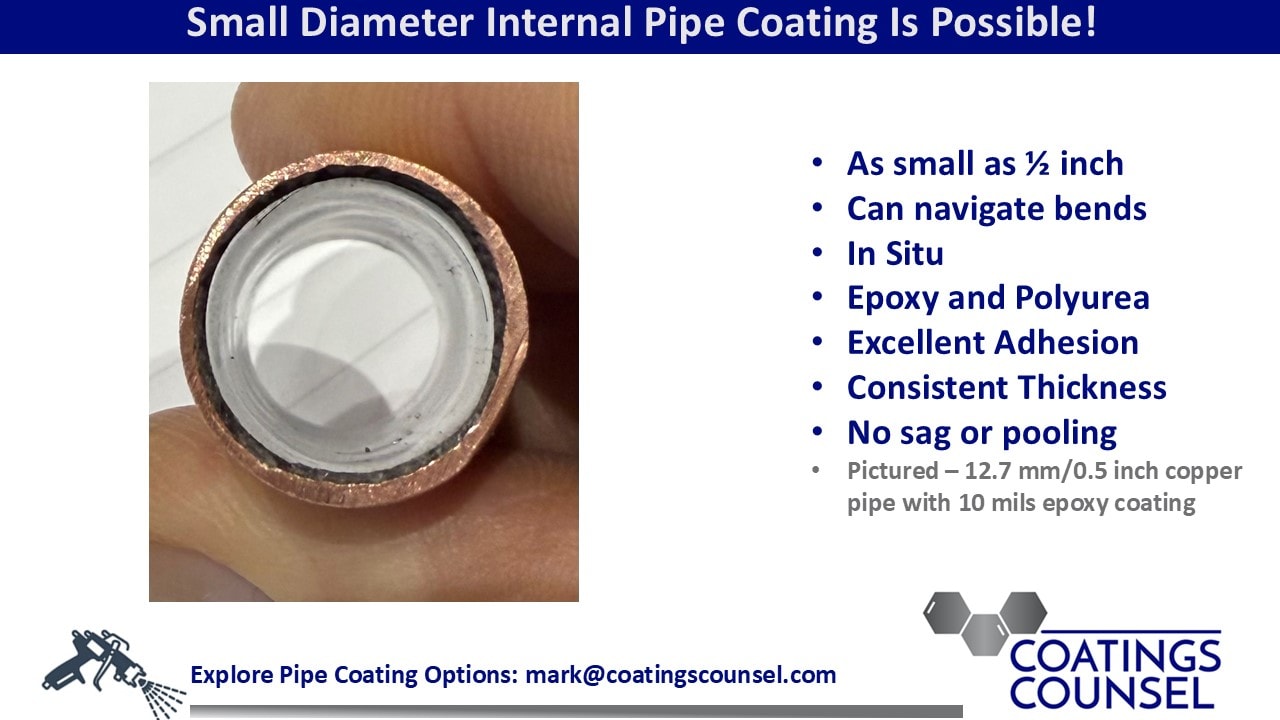
Small diameter internal pipe coating — 12.7mm copper pipe
½″ Small Diameter Capability
Pipeline rehabilitation trenchless technology
Trenchless Rehabilitation

SIPP (Spray-In-Place Pipe) technology eliminates the need for excavation by applying structural coatings from within the pipe — a paradigm shift in pipeline rehabilitation for water, sewer, and industrial systems.

Coatings Counsel provides specification, QC oversight, and contractor management for SIPP projects — from feasibility assessment through final inspection and documentation.

Trenchless rehabilitation for water, sewer, and industrial pipelines
Structural and non-structural lining system selection
CIPP vs. SIPP comparative analysis and recommendation
In-process QC and post-application inspection protocols
Regulatory compliance and documentation support
Why SIPP?
No dig
Trenchless — no excavation required
½″+
Works in pipes as small as ½ inch
NSF 61
Potable water compliant systems
50yr
Design service life
Discuss Your SIPP Project →
Small diameter internal pipe coating — 12.7mm copper pipe with 10 mils epoxy coating
SIPP Capability

Small Diameter Internal
Pipe Coating Is Possible

Pictured: 12.7 mm (½ inch) copper pipe with 10 mils epoxy coating — demonstrating that SIPP technology can rehabilitate pipes far smaller than most assume.

As small as ½ inch diameter
Can navigate bends in-situ
Epoxy and Polyurea systems
Excellent adhesion
Consistent DFT — no sag or pooling
Minimal disruption to service
Preferred Partner — Water & Wastewater

For Water & Wastewater,
We Recommend Warren Environmental

When our clients need a proven coating contractor for water and wastewater infrastructure, Warren Environmental is our preferred recommendation — a company whose products and application standards we trust completely.

Who Is Warren Environmental?

Warren Environmental is a US-based manufacturer and applicator of high-performance 100% solids epoxy lining systems, purpose-built for the water and wastewater industry. They are widely regarded as the gold standard for potable water, sewer, and wastewater infrastructure rehabilitation.

Manufacturer of their own 100% solids epoxy systems
NSF/ANSI 61 certified for potable water contact
Structural and non-structural lining solutions
Proven in manholes, wet wells, force mains, and tanks
Decades of documented performance in municipal infrastructure
Trained and certified applicator network across North America

What They Do

Warren Environmental specialises in the rehabilitation and protection of water and wastewater infrastructure using spray-applied epoxy linings — extending asset life, restoring structural integrity, and ensuring regulatory compliance.

Manhole & wet well rehabilitation
Stopping infiltration, restoring structure, eliminating H₂S damage
Potable water tank & pipe lining
NSF 61 compliant systems for drinking water contact
Force main & sewer lining
Trenchless rehabilitation of pressurised and gravity mains
Wastewater treatment plant structures
Chemical-resistant linings for digesters, clarifiers, and basins

Why Coatings Counsel Recommends Them

Our recommendation is based on direct experience with their products and application quality — not a commercial arrangement. When the stakes are high and the asset is critical, Warren Environmental delivers.

Consistent, high-quality application results in the field
Products engineered specifically for water infrastructure
Strong technical support and specification assistance
Proven long-term performance — not just short-term compliance
Coatings Counsel can provide independent QC oversight on Warren projects
Visit Warren Environmental →
Coatings Counsel can provide independent specification and QC oversight on Warren Environmental projects — ensuring the right system is specified and correctly applied.
Discuss Your Project →
Specialised Coating Systems

Corrosion Under Insulation
& Fire Protection

Two of the most technically demanding — and most frequently misspecified — coating applications in oil & gas and industrial facilities. Both require deep knowledge of the interaction between coating chemistry, substrate conditions, and the operating environment.


🌡

Corrosion Under Insulation (CUI)

One of the most costly and hidden failure modes in process industries

CUI occurs when moisture becomes trapped beneath insulation on piping and equipment, accelerating corrosion in a zone that is invisible during normal operation. It is responsible for a disproportionate share of piping failures in refineries, petrochemical plants, and power generation facilities — and is notoriously difficult to detect until significant damage has occurred.

What We Address
CUI coating system selection for operating temperature ranges (−4°F to 300°F+)
Specification of thermally-stable epoxy and inorganic zinc systems for insulated piping
Surface preparation requirements under insulation (SSPC SP-6 minimum, SP-10 preferred)
Insulation jacketing compatibility and moisture ingress prevention
Risk-based inspection (RBI) integration and CUI survey support
Thermal spray aluminum (TSA) specification for high-temperature CUI service
"CUI is not a maintenance problem — it's a specification problem. The right coating system, properly applied before insulation is installed, is the only reliable mitigation."
🔥

Passive Fire Protection (PFP)

Intumescent and cementitious coatings for structural steel and process equipment

Passive fire protection coatings are designed to maintain structural integrity during a fire event — buying time for evacuation and emergency response. Intumescent coatings expand dramatically when exposed to heat, forming an insulating char layer that slows heat transfer to the steel substrate. Specification errors in PFP can have catastrophic consequences and are subject to strict regulatory and insurance requirements.

What We Address
Intumescent coating selection for cellulosic and hydrocarbon fire scenarios
DFT specification for required fire resistance ratings (30, 60, 90, 120 min)
Primer compatibility with intumescent topcoat systems
Cementitious vs. intumescent selection for process equipment and vessels
Application QC — DFT verification, adhesion testing, and documentation
Third-party inspection and certification support
PFP is a life-safety system. It must be specified, applied, and inspected with the same rigor as structural engineering — not treated as a paint job.
Technology Partnership
Copsys Digital

Copsys Intelligent Digital Skin

Smart coating for tanks, pipes, and naval vessels — with embedded asset monitoring
www.copsys.ca
Naval Vessels
Naval Vessels
Hull & superstructure
Tanks & Pipelines
Tanks & Pipelines
Oil & gas, process piping
Embedded Sensing
Embedded Sensing
Real-time asset monitoring

Pipeline Armour — How It Works

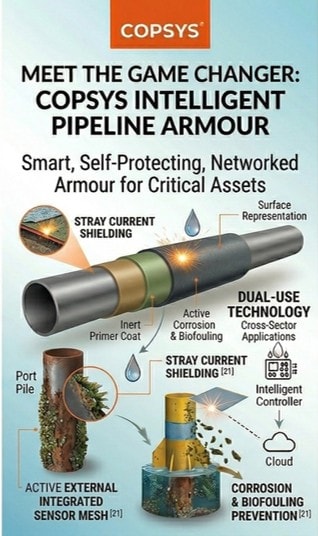
Smart, self-protecting, networked armour for critical assets

Copsys Intelligent Digital Skin — Pipeline Armour infographic showing stray current shielding, active corrosion and biofouling prevention, embedded sensor mesh, and intelligent controller

What Is Copsys Intelligent Digital Skin?

Copsys Intelligent Digital Skin is a smart protective coating for tanks, pipes, and naval vessels that integrates embedded sensing directly into the coating layer — turning a passive barrier into an active monitoring system.

Designed for external surfaces on tanks, above-ground and buried pipelines, and naval vessels, Intelligent Skin enables real-time corrosion detection, structural health monitoring, and predictive maintenance — without any shutdown or inspection access.

Real-time corrosion detection beneath the coating
Structural health monitoring — strain, temperature, impact
Predictive maintenance alerts before visible failure
No shutdown required for monitoring or inspection

Where It's Applied

Intelligent Skin is engineered for the most demanding asset integrity environments — tanks, pipelines, and naval vessels where conventional inspection is costly, infrequent, or impossible.

Storage tanks & pressure vessels
External surface monitoring, above-ground and buried
Above-ground & buried pipelines
Oil & gas, process piping, risers, offshore
Naval vessel hulls & superstructure
Continuous structural health data at sea
Offshore platforms & splash zones
Submerged and tidal zone structure monitoring

Our Role as Specialist Partner

Coatings Counsel bridges the gap between Copsys Digital technology and field deployment — providing specification, QC, and contractor management for Intelligent Skin projects on tanks, pipes, and vessels.

Feasibility assessment and system selection
Coating specification and surface prep requirements
Contractor qualification and application oversight
QC documentation and post-application inspection
Integration with existing asset integrity programs
Enquire About Copsys →
See Copsys In Action

Intelligent Skin — Video Demonstrations

Copsys Intelligent Skin Overview
An introduction to Copsys Digital Intelligent Skin technology — how embedded sensing integrates into the coating layer on tanks, pipes, and naval vessels for continuous asset monitoring.
Intelligent Skin Application & Monitoring
See how Intelligent Skin is applied to external surfaces and how the embedded sensor network delivers real-time corrosion and structural health data to asset managers.
For Specifiers

Specification Support & Technical Guidance

Getting the coating right starts long before the first brush stroke. Coatings Counsel works directly with engineers, owners, and project managers to ensure the right product is specified, the right contractor is selected, and the right outcome is achieved — every time.

Coating Selection

Independent, manufacturer-neutral guidance on the right coating system for your substrate, environment, and service conditions — epoxy, polyurea, polyurethane, or hybrid systems.

Specification Writing & Review

Drafting new coating specifications or reviewing existing ones for technical accuracy, completeness, and enforceability. Aligned with SSPC, NACE, AWWA, and project-specific requirements.

Application Guidelines

Detailed application method statements covering surface preparation standards, environmental conditions, mixing ratios, DFT requirements, cure schedules, and inspection hold points.

Product & Procedure Review

Evaluation of submitted products and application procedures against specification requirements. Identify substitutions, flag non-conformances, and provide written technical opinions.

Contractor Selection

Pre-qualification support, bid evaluation, and contractor vetting — assessing capability, experience, equipment, and QC programs to ensure the right applicator is awarded the work.

Independent QC Oversight

Third-party quality control during application — DFT checks, holiday detection, adhesion testing, and inspection reports that protect the owner and hold contractors accountable.

Working on a project specification?
Reach out early — the best time to get coatings right is before the spec is issued.
Contact Coatings Counsel
For Coatings Contractors

Fractional Sales & Business
Support for Contractors

Running a coatings contracting business means wearing every hat at once — estimating, sourcing, hiring, selling, and executing. Coatings Counsel offers a unique Fractional Sales & Operations model that gives your business access to senior-level expertise without the cost of a full-time hire.

What is Fractional Sales?

A Fractional Sales professional is a senior-level sales and business development expert who works with your company on a part-time, subscription basis — delivering the strategy, relationships, and execution of a full-time VP of Sales at a fraction of the cost.

For coatings contractors, this means access to deep industry knowledge, established manufacturer relationships, and proven business processes — without the overhead of a full-time senior hire.

Who It's For
Coatings contractors looking to grow revenue and win larger projects
Businesses that need sales and estimating support but can't justify a full-time hire
Contractors entering new markets (water/wastewater, oil & gas, industrial)
Companies needing help with equipment sourcing, staffing, or supplier negotiations
Owners who want to step back from day-to-day sales and focus on operations
What's Included
📊
Estimating & Quoting
Develop accurate, competitive estimates for industrial coating projects — including material takeoffs, labor calculations, equipment costs, and margin analysis.
🔍
Project Sourcing
Identify and pursue the right opportunities — bid boards, owner relationships, GC networks, and direct industrial client development.
🧪
Coating Selection Support
Ensure your team is specifying and quoting the right coating system for each project — avoiding costly substitutions and change orders.
🏗
Equipment Sourcing
Guidance on spray equipment selection, plural-component systems, surface prep equipment, and supplier negotiations for capital purchases or rentals.
👥
Hiring & Staffing
Support for recruiting qualified applicators, foremen, and project managers — including job descriptions, interview criteria, and onboarding frameworks.
🤝
Manufacturer Relationships
Leverage established relationships with coating manufacturers and distributors to secure better pricing, technical support, and preferred applicator status.
Subscription Packages

Fractional Sales engagements are structured as monthly retainers with a defined hour commitment. Choose the level that fits your current needs — scale up or down as your business grows.

10 hrs
per month · Starter
Monthly strategy call
Bid review and go/no-go guidance
Coating selection consultation
Email support
Most Popular
20 hrs
per month · Growth
Everything in Starter
Estimating and quoting support
Supplier and equipment sourcing
Project pursuit strategy
Bi-weekly check-ins
40 hrs
per month · Partner
Everything in Growth
Hiring and staffing support
Manufacturer relationship management
Full sales pipeline management
Weekly calls + on-site as needed
Custom
Tailored engagement
Project-based or retainer
Defined scope and deliverables
Ideal for specific initiatives
Contact us to discuss
Discuss a Fractional Engagement →
Why Coatings Counsel

16 Years of Expertise.
Your Project's Best Interest.

When a coating fails, the consequences are measured in millions of dollars, regulatory penalties, and safety incidents. The difference between success and failure is almost always in the specification and oversight — not the product itself.

Coatings Counsel brings 16 years of hands-on experience across every major coating chemistry and industrial sector. We work with preferred manufacturers and trusted suppliers — including Warren Environmental for water and wastewater applications — while always prioritising the right solution for your project over any single product line.

Now in our third year of independent consulting, we've built a track record of successful projects across water infrastructure, oil & gas, CUI mitigation, fire protection, and advanced coating technologies.

Work With Us
🎯
Your Project First
We work with preferred manufacturers and trusted suppliers — but our primary obligation is always to your project outcome, not to any product line.
🔬
Deep Technical Knowledge
From surface preparation standards to coating chemistry, application physics, CUI, fire protection, and failure analysis — we speak the language of coatings.
📋
Specification Authority
We write specifications that hold up — in the field, in disputes, and in court. Precise, defensible, and contractor-ready.
SIPP & Emerging Technologies
At the cutting edge of spray-in-place pipe lining and smart coating systems including Copsys Digital Intelligent Skin.
🤝
Contractor Partnership
Unique Fractional Sales model gives coatings contractors access to senior expertise for estimating, sourcing, hiring, and business development.
Proven Track Record
Multiple successful projects completed across water infrastructure, oil & gas, and industrial sectors in our first three years.
Coatings Counsel Insights

Knowledge That Protects
Your Assets

From understanding the difference between a coating and a liner, to avoiding costly failures, to knowing when cold welding beats a shutdown — this is the kind of practical knowledge Coatings Counsel brings to every project.

Industrial steel pipes cross-section showing interior coating

Coating vs. Liner — Know the Difference

COATING
1.0 – 125 mils DFT
Mechanical or chemical bond to substrate
LINING
125 – 500+ mils DFT
Bonded or un-bonded
"Some say: Coating on the exterior, Lining on the interior."
Ask us about your project →
Coating failure — cracking and peeling on industrial surface

Failures Can Be Avoided

Cracking / Crazing
Blistering
Delamination
Pinholes / Holidays

The very first step — before surface prep and trained applicators — is choosing a coating that is "fit for purpose."

Get the right spec from the start →
Aircraft maintenance — there's always a better solution than a temporary fix

Duct Tape Isn't Always the Answer

Coatings & linings can prevent, repair, and improve your assets. There's always a better solution than a temporary fix.

Prevent corrosion before it starts
Repair damaged assets without full replacement
Improve flow efficiency and service life
Reduce long-term maintenance costs
Let us help you find a better solution →
Severe rust and corrosion on industrial steel — 5 tons lost every second

Rust Never Sleeps

5 tons
of steel lost to corrosion every second
$2.5T
global cost per year — 3.4% of GDP

Corrosion is relentless. The right protective coating system — properly specified, sourced, and applied — is the most cost-effective defense available.

Contact us for corrosion protection →
Pipe leak repair — cold welding and live leak repair in action

Cold Welding & Live Leak Repair

Faster, cheaper, stronger — and no shutdown required. Cold welding and live leak repair for pipes, tanks, and any metal substrate.

No open flame or welding permits
Can be done by company personnel
No need for shutdown
Pipes, tanks, any metal substrate
Explore your maintenance options →
Custom coatings and linings training — in-person and virtual

Custom Coatings & Linings Training

Kick-off meetings, training events, and brainstorming forums — in-person and virtual — to inform your teams on the options and capabilities of construction chemicals.

Custom-designed for your team and industry
In-person or virtual delivery
Coating selection, surface prep, QC fundamentals
Add us to your next project kick-off agenda
Add us to your agenda →
Free Tool

Coatings Counsel Coating Calculator

Theoretical coverage, wet film thickness, surface area, and material quantities — built on the same formulas used by coatings professionals.
C4 Coating Calculator app
C4 — Coating Calculator App
Coverage CalculatorSurface Area CalculatorWFT / DFTImperial & MetricWaste FactorMaterial to Order

Calculate theoretical spreading rates, wet film thickness, surface areas for tanks, pipes, manholes, and more. Free to use — no login required.

Open Calculator
WFT Formula
DFT ÷ (VS% ÷ 100)
Spreading Rate
(VS% × 1604) ÷ DFT
Surface Shapes
9 geometries
Technical Resources

Learn More About Coatings

Practical reference documents developed from 16+ years of field experience. Download and share freely — our goal is to raise the standard of coatings knowledge across the industry.

Comparison

Coatings Comparison Chart

A side-by-side comparison of the most common industrial coating types — epoxy, polyurea, polyurethane, and more — across key performance criteria including chemical resistance, temperature range, flexibility, and application method.

Download PDF →
Technical Reference

Comparison of Industrial Coatings

Detailed technical comparison of industrial coating systems with performance data, substrate compatibility, and specification guidance for engineers and asset owners selecting the right system for their environment.

Download PDF →
Water & Wastewater

AWWA Class 1–4 Differences with SIPP References

Explains the four AWWA coating classes for water and wastewater infrastructure, their performance requirements, and how SIPP (Spray-In-Place Pipe) technology aligns with each classification for rehabilitation projects.

Download PDF →
Geotextile

HDPE vs. Polyurea Sprayed Geotextile

Comparative analysis of HDPE liner systems versus polyurea-sprayed geotextile for containment and geosynthetic applications — covering installation, performance, chemical resistance, and long-term cost considerations.

Download PDF →
Testing & QC

Explaining the Taber Abrasion Test

A clear explanation of the Taber Abrasion Test — how it works, what it measures, and how to interpret results when evaluating coating wear resistance for floors, linings, and high-traffic surfaces.

Download PDF →
Testing & QC

Taber Abrasion Test Wheel Types

Breaks down the differences between Taber Abrasion test wheel types (CS-10, CS-17, H-18, H-22 and others) — helping specifiers and QC professionals select the correct wheel for their coating evaluation.

Download PDF →
Have a specific technical question? Mark Murphy — General Manager & Senior Coatings Consultant — is available for direct consultation.
Ask Mark Directly →

Ready to Get the Right Coating Specified?

Whether you're specifying a new project, evaluating a supplier, troubleshooting a coating failure, or looking for Fractional Sales support — Coatings Counsel is ready to help.

Contact Us Today
Mark Murphy
General Manager & Senior Coatings Consultant
Based in Canada — Experience Worldwide
[email protected]+1 647-786-1679
Canada — Experience Worldwide